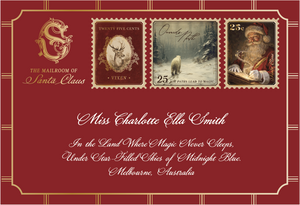


The question arrives in every believing household eventually, usually in the first week of December, delivered with great seriousness at bedtime: how will Santa get in when we don't have a chimney?
It is a fair question. Most Australian homes were built without one, and children are careful auditors of Christmas logistics. The answer parents have settled on for generations is a small, satisfying piece of magic: Santa carries no keys of his own, so each family leaves one out for him. A magic key, made only to open the door of the home it belongs to, on one night of the year.
What is Santa's Magic Key?
A Santa key is a special key, usually brass, that hangs on or beside the front door on Christmas Eve. It has no ordinary teeth and fits no ordinary lock. The magic works like this: when Santa arrives at a home without a chimney, he looks for the key, lets himself in, does his quiet work by the tree, and locks up behind himself on the way out. In some families the key is engraved or ribboned; in ours, it is solid brass, engraved with a red 25, because the 25th of December is the one day all that magic is for.
How the tradition works on Christmas Eve
The ritual is simple enough for a toddler to lead, which is rather the point.
- After dinner on Christmas Eve, the key comes out of its box. This is a moment worth sharing, the way stockings and biscuit plates deserve their own small ceremony.
- Your child hangs the key on the front door, or somewhere just beside it. A hook, a nail, a ribbon over the handle. Santa knows where to look.
- In the morning, the key is exactly where it was left (or perhaps its magically moved around a little), which is proof of the most reassuring kind: he let himself in, he locked up after, and everything is as it should be.
- The key goes back into its box, ready for next year.
What if we don't have a chimney?
Then the key was made for you. That is the entire reason it exists. Apartments, townhouses, farmhouses with wood heaters, homes with chimneys too narrow for a man of Santa's build: the key covers every one of them. And for homes that do have a fireplace, plenty of families use the key anyway, because a locked flue or a lit fire on a cold Christmas Eve raises the same bedtime questions.
Is it the same as the Father Christmas key?
Yes. In Britain and in many Australian families with British roots, the same tradition is known as the Father Christmas key or the magic door key. Different name, same magic, same small hands hanging it on the door.
What age is the tradition for?
The key earns its keep from the toddler years, when children first start asking how things work, right through to the last believing Christmas. Because it is a keepsake rather than a toy, it also outlasts belief: grown children have been known to hang the family key long after they know who really eats the biscuits, simply because Christmas Eve would feel wrong without it.
Making it part of your Christmas
The strongest traditions are the ones with more than one thread. Many families pair the key with a letter from Santa that mentions he will let himself in, or with flour boot prints leading from the front door to the tree on Christmas morning, so the whole story holds together from every angle a sharp-eyed child might check. However you build it, the key is the kind of tradition that costs two minutes a year and gets remembered for decades.


